Selected Work

NeuraLyfe

A helmet add-on and sideline app that show football medical staff which players’ brains are at risk, and which hit caused it.

NeuraLyfe project visual

Intro

A sideline call that cannot wait for symptoms

NeuraLyfe is a sideline decision-support system that helps football medical staff catch brain-impact risk before it becomes irreversible. It was designed and built in four days, March 6 to 9, 2026, for the FigBuild 2026 hackathon, entirely in Figma Make.

It tackles Chronic Traumatic Encephalopathy (CTE): a degenerative condition from repeated head impacts that accumulates invisibly and can't be confirmed until after death.

I ideated the concept and helped the team choose it over a rougher direction around dreams, where the pain point never got sharp. Across those four days, I modeled and 3D-printed Halo, the helmet add-on, designed and built the Impact Replay interface, and co-designed the Roster View.

It won 1st Place out of 690 teams.

Role

Product Designer · Maker

Timeline

4 Days · March 6 to 9, 2026

Team

Malik Zhang Cindy Ly Naomi Boruchowicz Jimmy Huang

Scope

Problem Framing Halo, Modeled and 3D-Printed Impact Replay Product Narrative

Outcome

1st Place of 690 Teams $10,000 Grand Prize

Tools

Figma Make · Figma Rhino 3D · KeyShot · Bambu Lab X1C
Highlights

From helmet signal to a decision in seconds

Turning raw helmet-sensor signals into fast, confident sideline decisions that catch cumulative brain risk before symptoms appear.

CTE in 91% of examined NFL playersCumulative impact, not just big hitsHalo: EEG · biomarkers · impact cameraRoster → Brain → Impact Replay

Invisible problems require visible systems.

Roster View

Triage the whole team at a glance

Brain View

Where neurological stress is building

Impact Replay

Trace an alert back to the play

Halo

The sensing layer of EEG, biomarkers, and an impact camera

Situation

Thousands of hits, and only the visible ones get checked

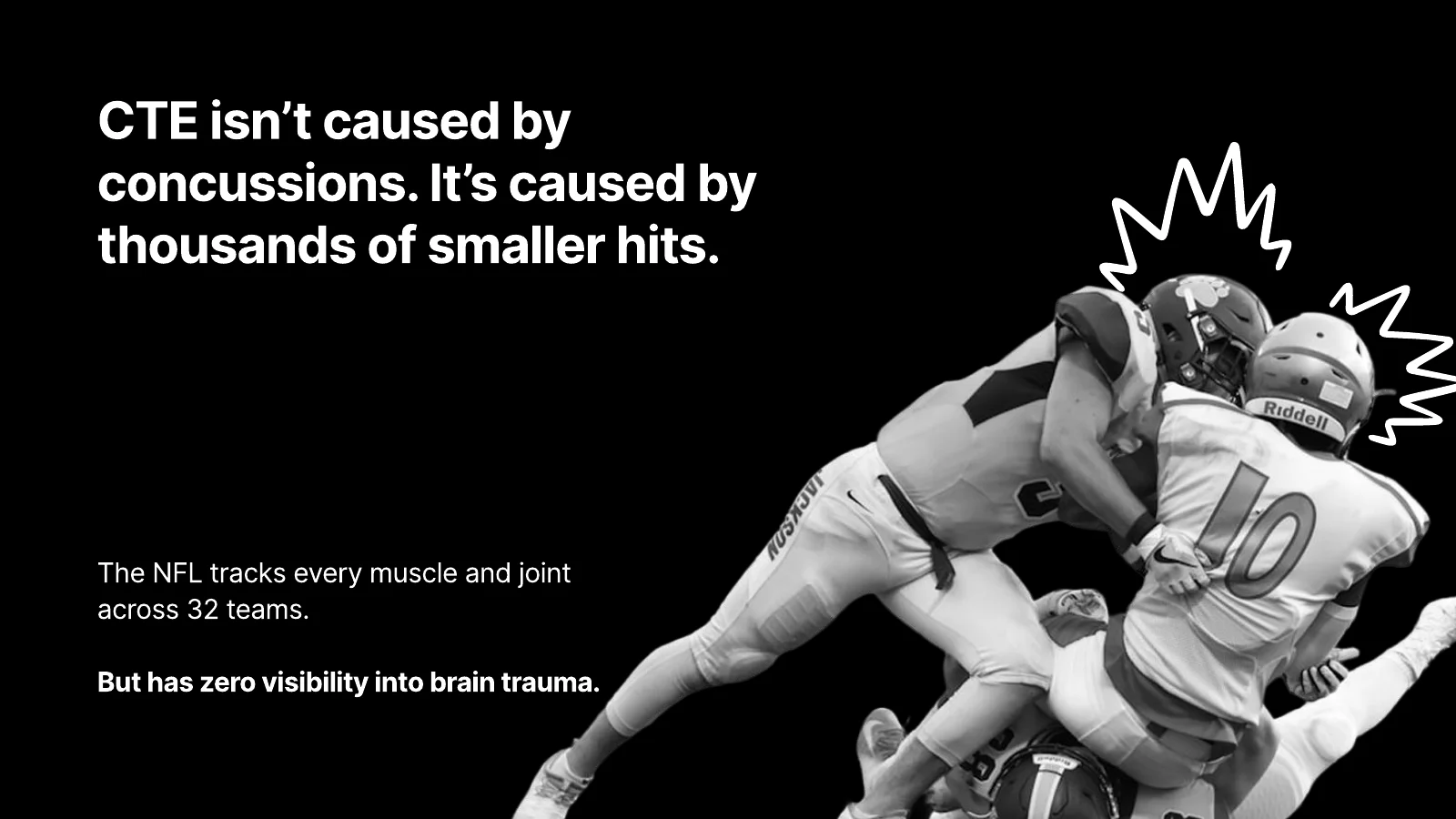
Football players take thousands of hits across a career, and repeated sub-concussive impacts are strongly linked to long-term brain damage. Sideline checks only catch visible symptoms, and by then the damage is done.

Repeated sub-concussive hits accumulate into long-term brain damage

Staff need to see cumulative impact as it builds, not react once symptoms show.

Research

Helmets measure force, not what the brain did

Helmet sensors today capture force, not how the brain responded. The signal that matters, cumulative neurological stress, goes unmeasured.

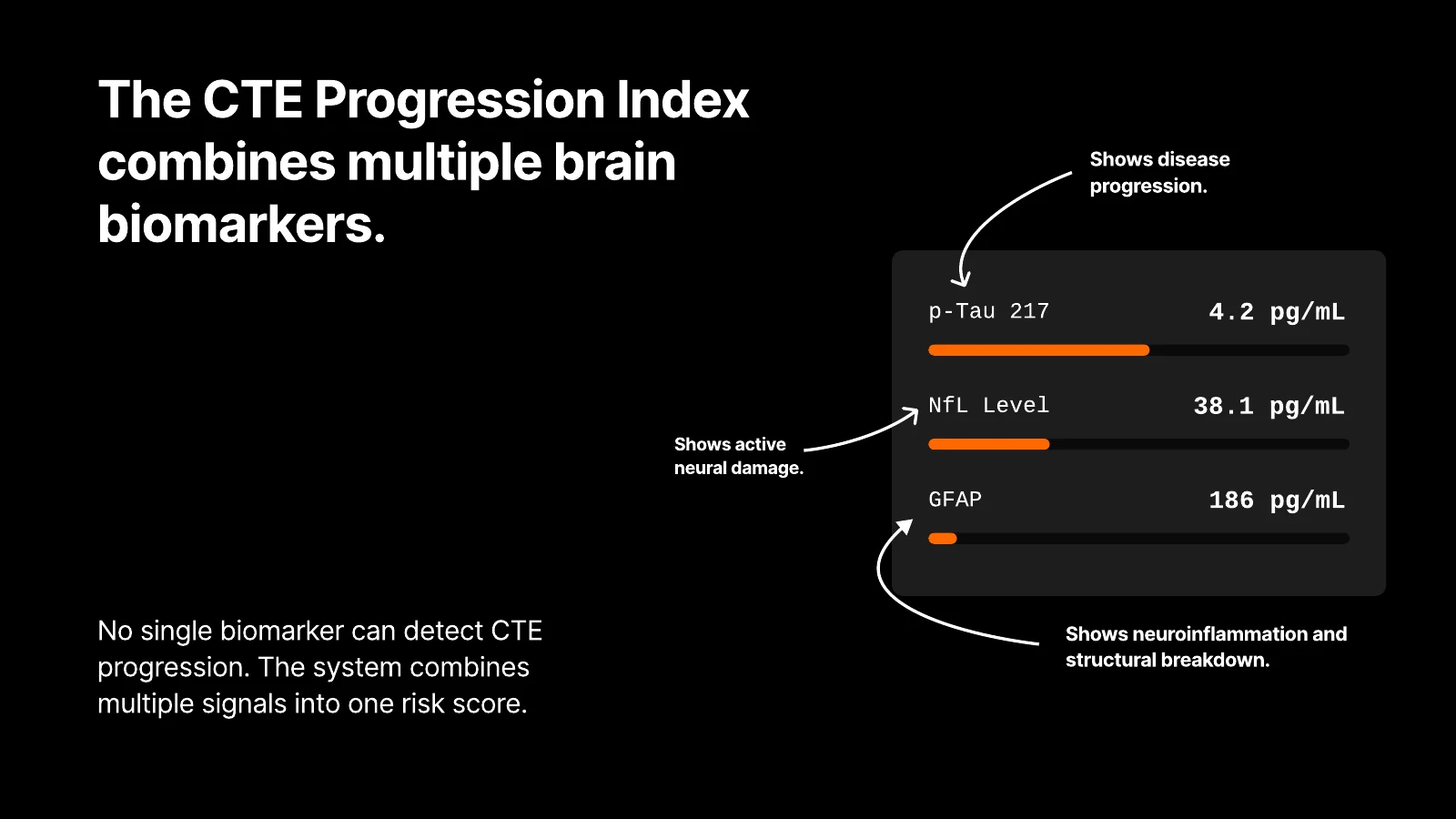
The CTE Progression Index combines the biomarkers p-Tau 217, NfL, and GFAP into a cumulative risk signal

The biomarkers are real: p-Tau 217, NfL, and GFAP are each linked to neurodegeneration in published research. Combining them into a live CTE Progression Index is the speculative step, and we kept that line visible instead of letting the index pass as settled science.

The opportunity: track brain-impact risk as it builds, not just flag individual hits.

Design Challenge

Too much data overwhelms. Too little loses trust.

The core problem was interpretive, not technical: show too much data and it overwhelms; simplify too much and it loses credibility.

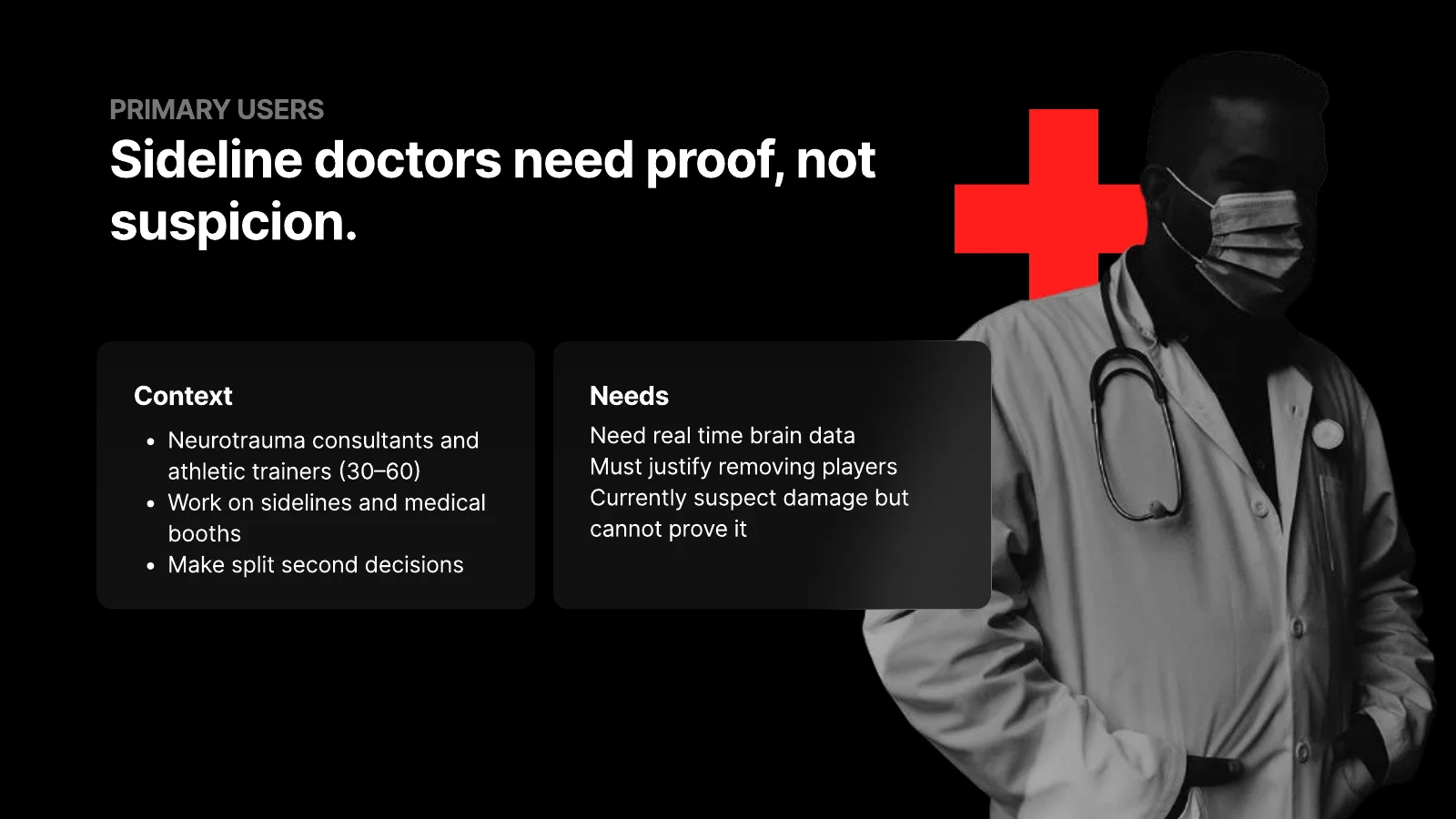
Sideline doctors need proof, not suspicion

The question I kept returning to: what does a sideline medic need to know in the next five seconds?

System Direction

Sensing is half the system. Reading it is the other half.

Two decisions fixed the shape of the system before any screen existed: where the sensing lives, and who acts on what it finds.

Where the sensing lives

  • Forehead patch: reads like science fiction, and every player would have to be talked into wearing one

  • Wrist or limb band: too far from the injury to say anything about the brain

  • Chosen · Helmet add-on: on equipment every player already wears, and localised to where the damage happens

Who acts on it

  • The player: self-reporting fails by design when the person with the most reason to stay in controls the diagnosis

  • Chosen · Medical staff: the one actor with the authority to pull a player and no incentive to keep them on the field

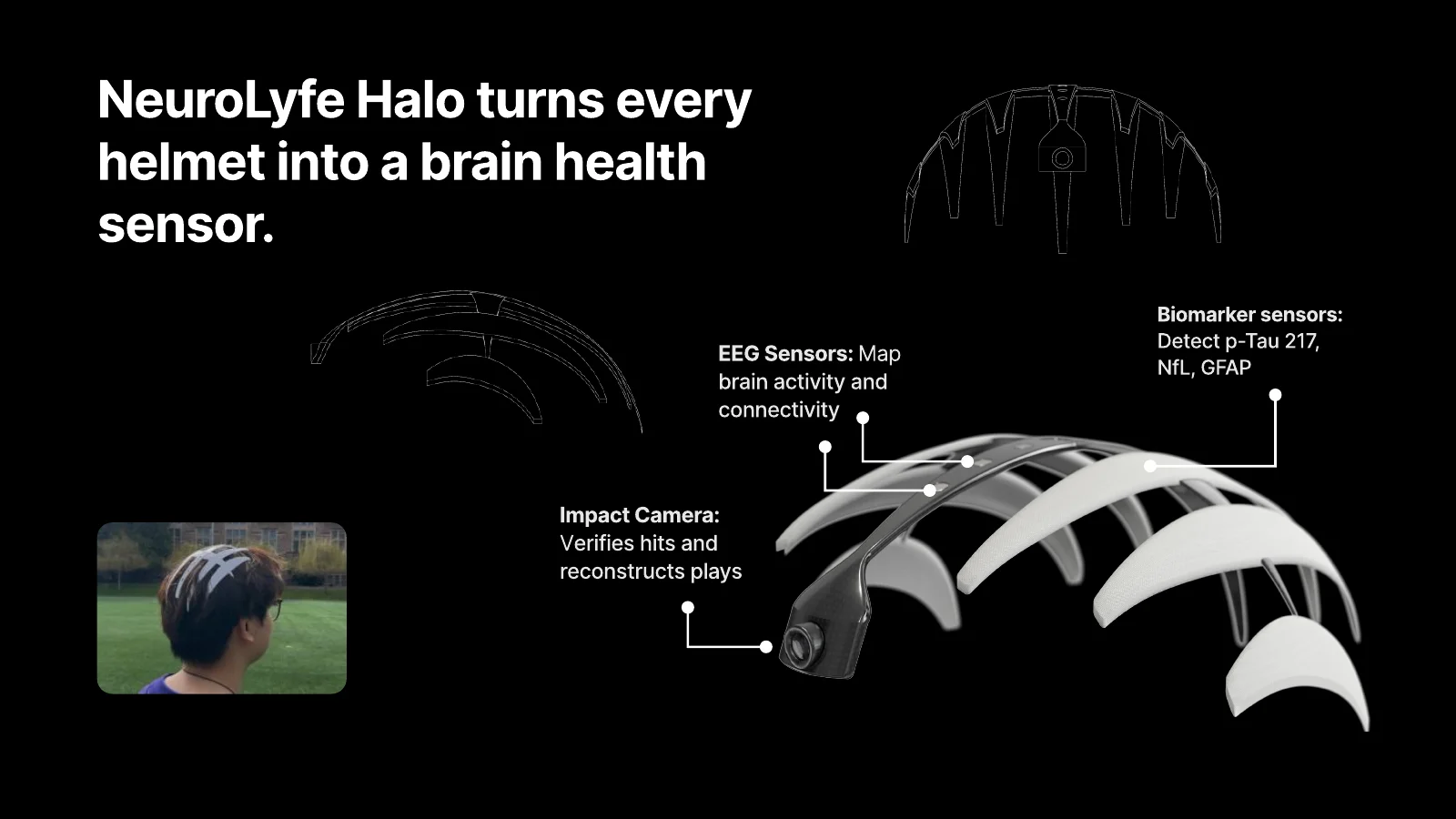
Halo, a helmet add-on, senses what force data can't: EEG for brain connectivity, biomarkers for early neurological stress, and an impact camera that reconstructs hits.

NeuraLyfe Halo turns any helmet into a brain-health sensor with EEG, biomarker, and impact-camera sensing

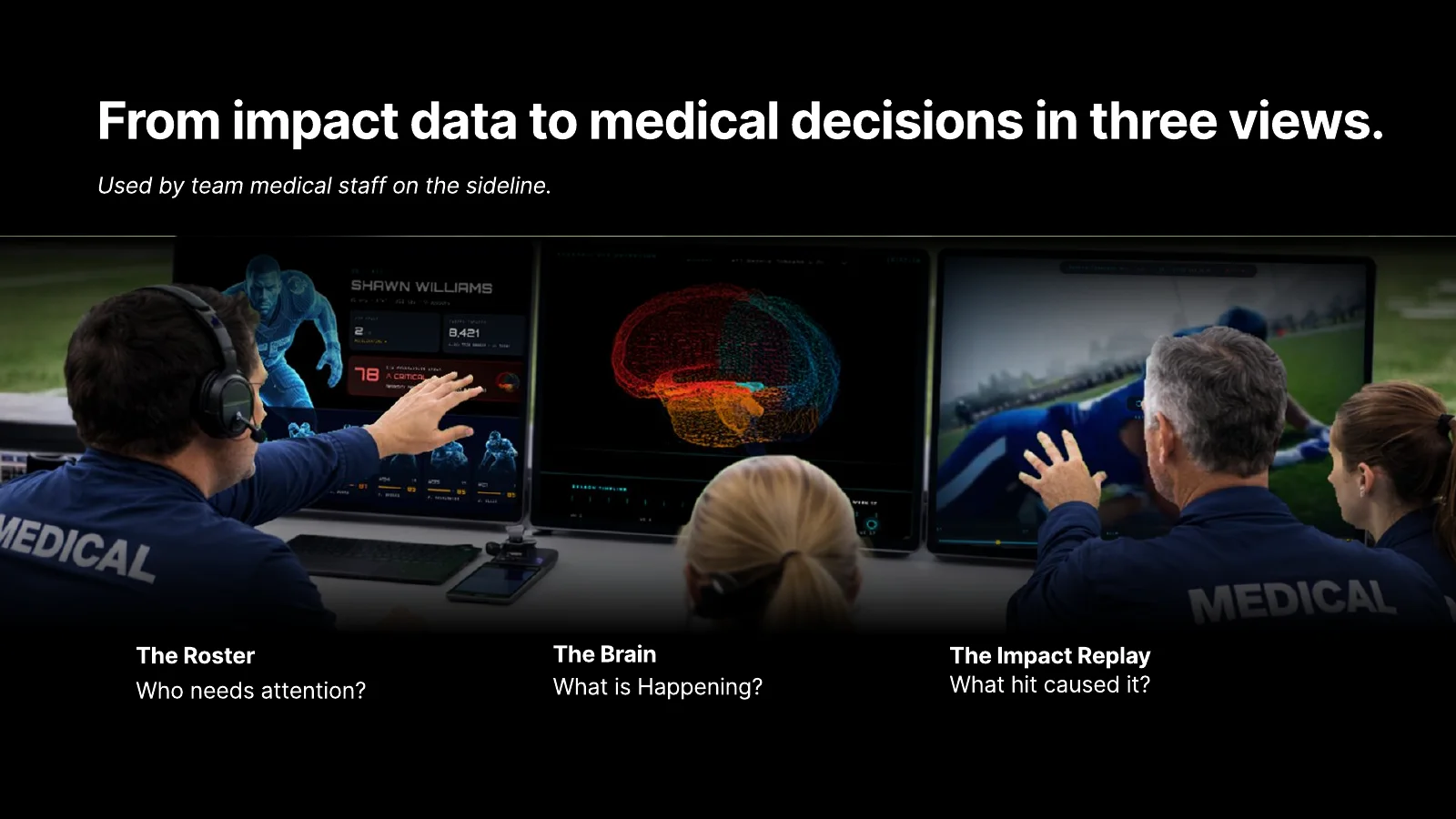
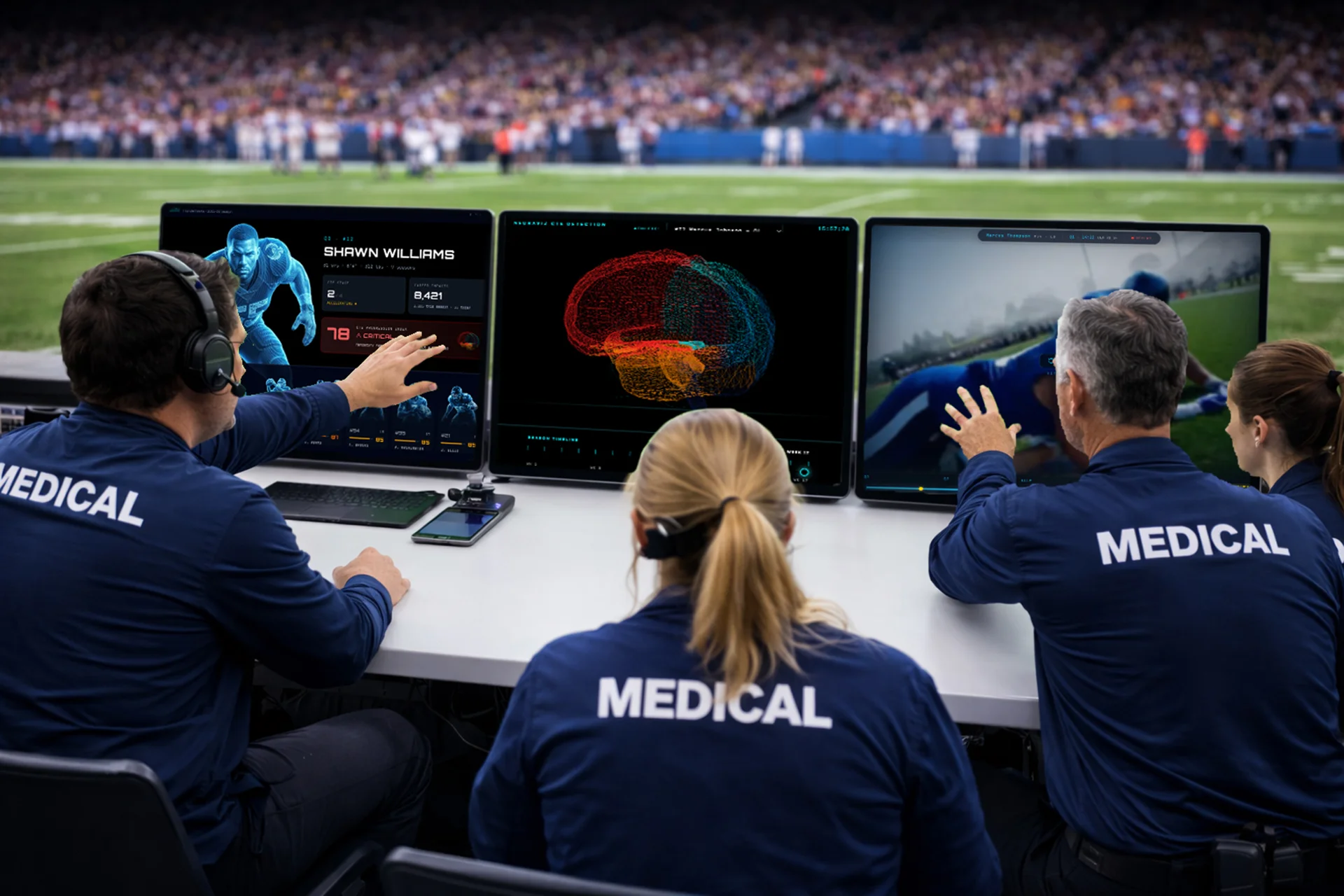
The sideline interface turns those signals into three questions: who needs attention, what's happening in their brain, and what caused it.

Design Process

Triage first, depth only when asked

Staff can't explore data mid-game, so the interface leads with triage and reveals depth only on demand:

· Roster View: who needs attention, at a glance

· Brain View: where stress is building

· Impact Replay: which play caused it

From impact data to medical decisions in three views: Roster, Brain, and Impact Replay

I pressure-tested one question throughout the Figma Make build: can staff go from alert to decision in seconds?

Final Design

Three views, and the hardware that feeds them

Halo

An add-on, not a new helmet, so teams keep the equipment they already trust. EEG maps brain connectivity, biomarker sensors catch early damage indicators, and the impact camera ties each force event to a moment on the field.

I modeled the Halo in Rhino, rendered it in KeyShot, and printed it on a Bambu Lab X1C within the four days, so the sensing layer existed as an object on the table and not only as a render on a slide.

Roster View

Ranks players by medical urgency, weighing cumulative impacts, recent hit severity, and brain health, so a static player list becomes a live risk map.

Brain View

Maps neurological stress by region in 3D. A risk score says how much. Brain View shows where, which matters most when repeated impacts hit the same region.

Impact Replay

Traces an alert back to the exact play: when the hit happened, how severe it was, which regions were affected, and whether to pull the player now.

The Protocol

Sensing only matters if it ends in a call someone can defend. Every player sits in one of five states, and the last two are not advisory.

  1. 01Baseline
  2. 02Spike
  3. 03Elevated
  4. 04Critical
  5. 05Removed

The data is the player's

It travels with them across teams and into retirement, not with the franchise.

Removal cannot be overridden

A Critical alert is not advisory. Nobody on the sideline can suppress it.

Together: identify risk, inspect impact, act with context.

Impact

Risk should not stay hidden until symptoms appear

NeuraLyfe's claim: brain-injury risk shouldn't stay hidden until symptoms appear.

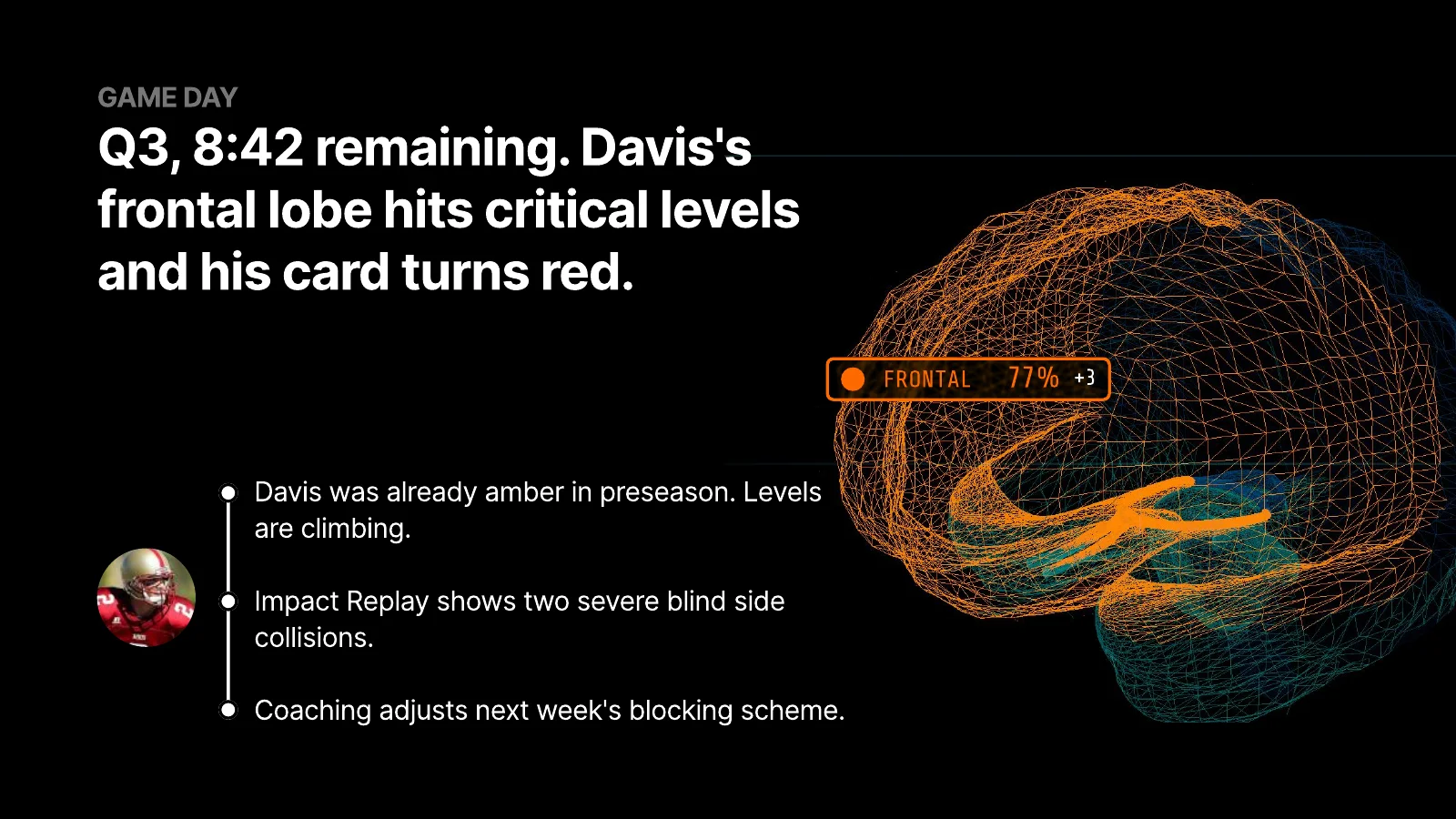
In a live scenario, a player's frontal lobe hits critical levels and his card turns red

Result

1st

Place, FigBuild 2026

Field

690

Teams entered

Builders

2,184

People competing

Prize

$10,000

Grand prize

What the judges recognised

VisualsThe filmStorytellingThe 3D-printed Halo

The judges recognised the visuals, the film, the storytelling, and especially the Halo prototype, which could be picked up rather than imagined.

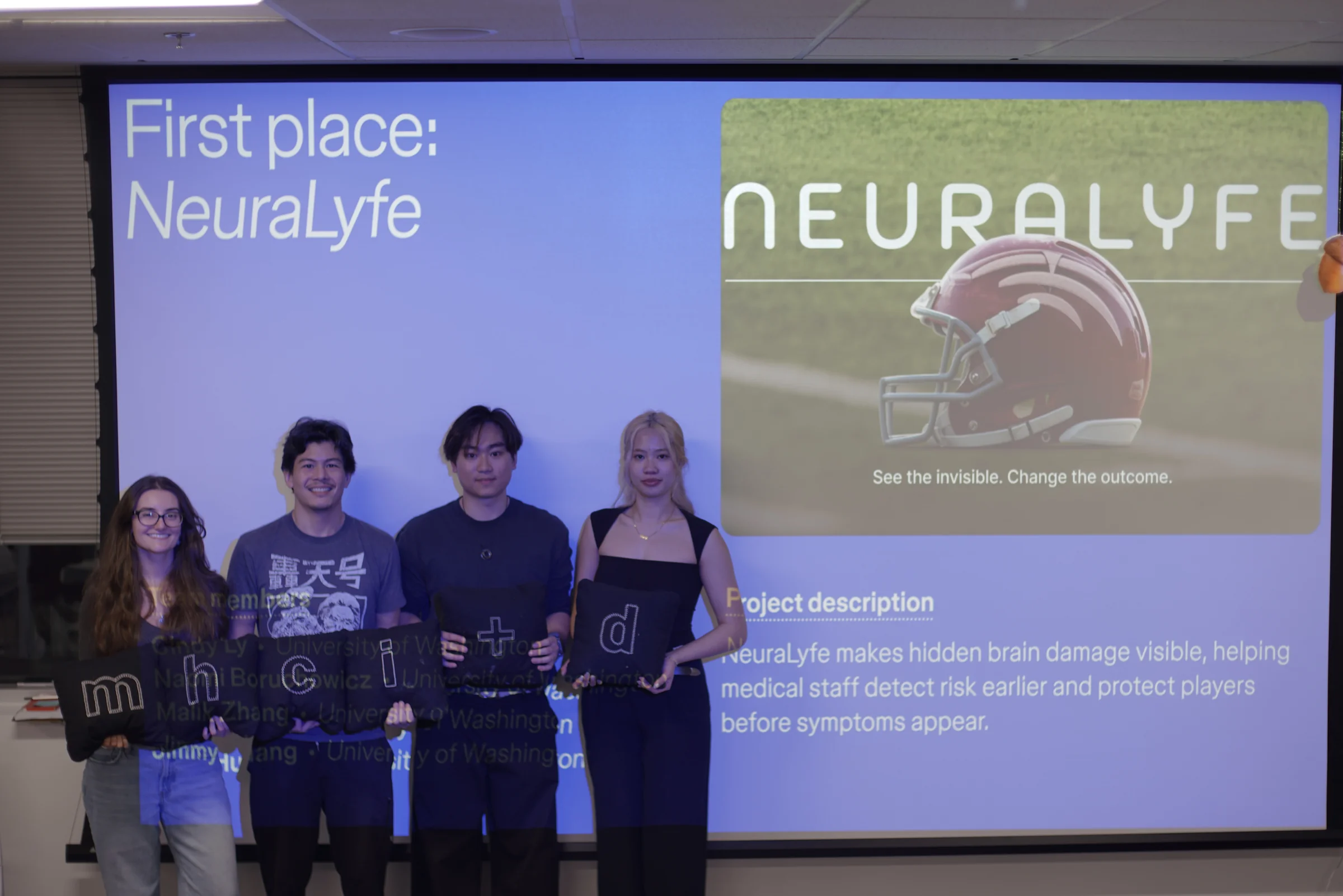
The four NeuraLyfe teammates holding MHCI+D letter cushions in front of the projected First place: NeuraLyfe slide at the FigBuild 2026 awards

Reflection

Designing for interpretation, not just accuracy

Designing for health means designing for interpretation, not data display. A system can collect perfectly accurate signals, but if staff can't read them under pressure, those signals never become care.

High-Pressure Interfaces Need Different Logic

The first question is never "what does all the data say?" It's "who needs help right now?" That pushed me to cut competing information and make the most urgent cases immediately visible.

What I Would Do Next

Clinical validation with sports-medicine professionals, testing whether the decision flow holds up in real sideline calls.

NeuraLyfe showed me that making hidden risk visible is a design problem. The harder part is making that visibility useful when it matters most.

Next up

Oryne

0→1 Product Designer & Builder · 2026App Store
AI-NativeMotion DesignDesign Engineering

Locant

0→1 Product Designer & Builder · 2026GitHub
AI-NativeDesign Engineering
Aura

Aura

Product Designer · 2025
Hardware UXUX ResearchPhysical Prototyping