A playable fishing prototype that turns real-world casting and reeling gestures into calm, responsive play.
Built with Claude, p5.js, and a Circuit Playground Express. No buttons, just gestures.
Context
No buttons. The rod is the controller.
Studio Waters is a playable, motion-controlled fishing prototype built with Claude and p5.js. No buttons, just real-world gestures.
Players cast and reel through physical motion, read by a Circuit Playground Express. The project chases one design question: how can motion, timing, and feedback shape a calm, engaging interaction?
Role
Designer · Builder
Timeline
Spring 2026
Team
One Designer · Vibe Coded
Scope
Embodied Interaction · Game Feel · Physical UI
Outcome
Playable CPX Prototype
Tools
Claude · p5.js · Circuit Playground Express
Inspiration
Fishing runs on waiting, not action
Fishing runs on pacing and anticipation, not constant action. I wanted to borrow that rhythm, not simulate the sport: the arc of a cast, the tension of a reel, the quiet between attempts.
The body becomes the interface, with repetitive physical motion as the source of immersion, something most games actively work against.
How It Works
Swing to cast, tilt and pull to reel
Simple physical gestures map directly to game states:
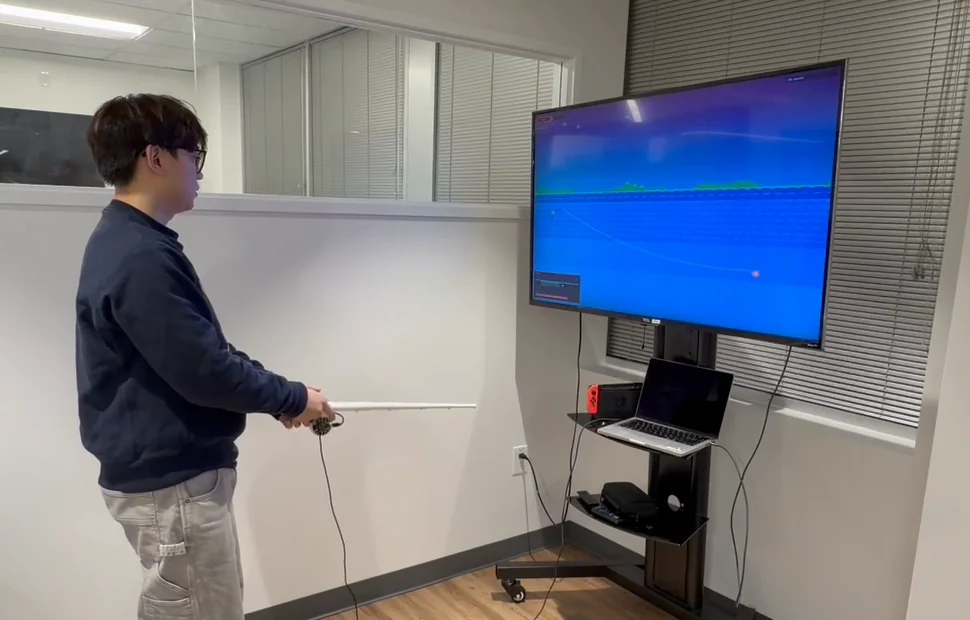
· Swing to cast the line into the water
· Tilt and pull to reel the fish back in
· On-screen feedback tracks tension, timing, and outcome
The target: obvious on first try, no tutorial required.
Playtest: the swing is the input, read by the Circuit Playground Express in the rod
Experience Design
The fish set the difficulty, not the buttons
A nostalgic pixel world and restrained UI keep the focus on the gesture. The screen supports the motion, not the other way around.
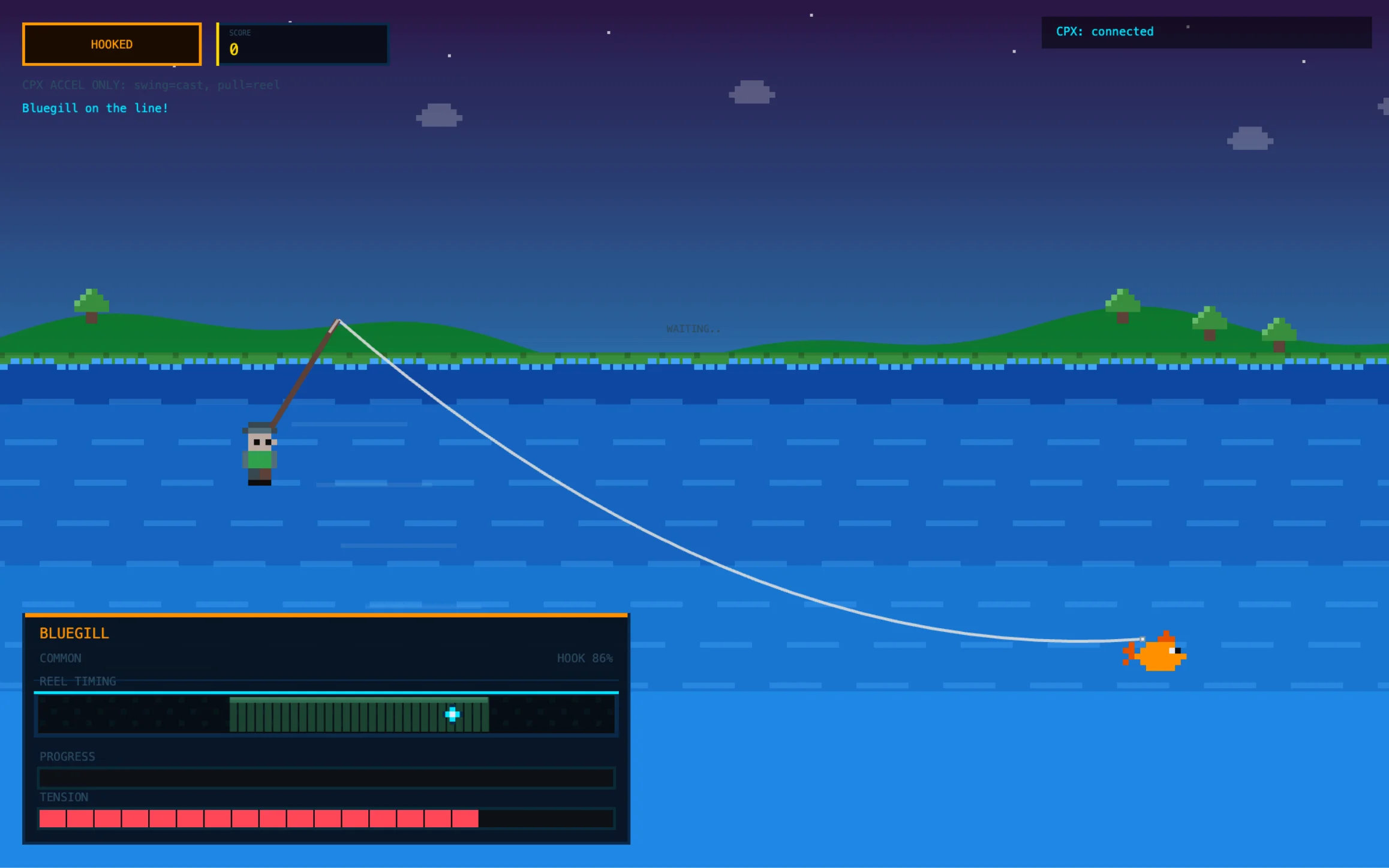
Difficulty comes from fish behavior: different species require different timing and tension, rewarding rhythm over fast reaction. The loop is tight and forgiving, with tension visible on screen and success felt in the motion.
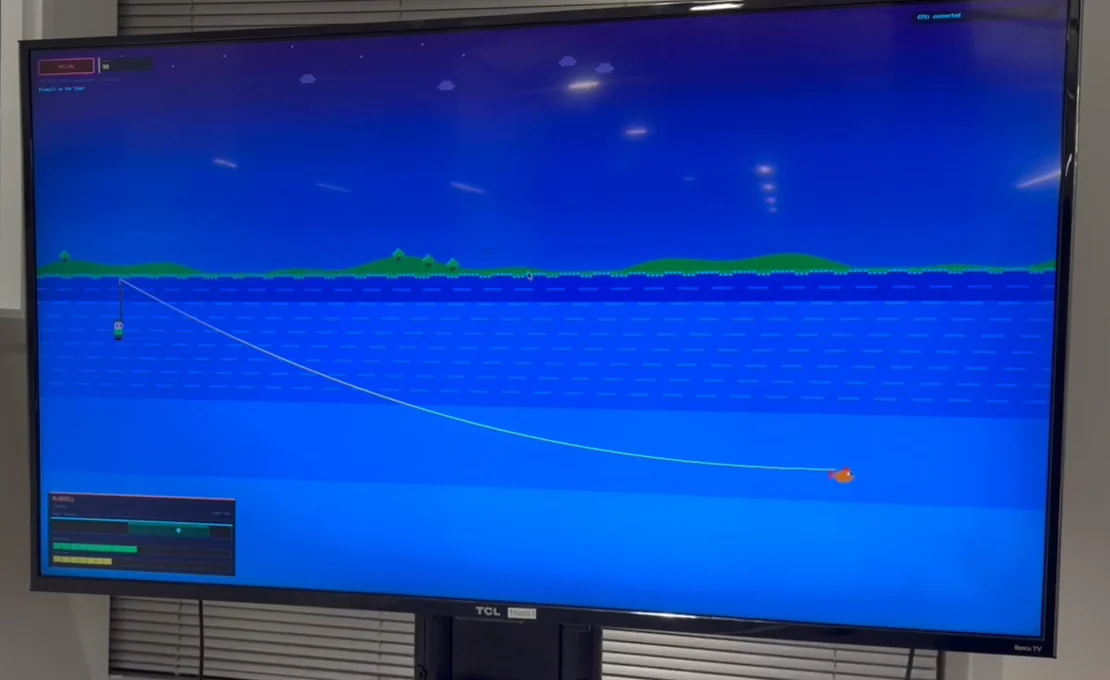
On the line: the cast arcs out, a fish takes it, and the readout at bottom left is the tension to hold
How I Used AI
AI wrote the scaffold. The feel was tuned by hand.
AI was my rapid prototyping tool:
· Claude generated the initial p5.js game structure
· Prompting rounds refined the visuals toward a cohesive pixel style
· AI-drafted interaction logic gave me a base to tune by hand
The real refinement was physical: tuning sensor thresholds, adjusting difficulty, and restructuring the code around how the CPX actually behaves under motion, which is what testing reveals and generation cannot.
Reflection
Restraint is the unexplored space in physical computing
The AI wrote the scaffold; I designed the feel. Vibe coding lowers the barrier to building, but the interaction only got good through intentional mapping and hands-on refinement.
It also surfaced an underexplored space: most physical computing projects chase spectacle. There is real design value in restraint, in play that is slow, rhythmic, and embodied.